Best free ai video generator : Synthesia
Best free ai audio generator.(realistic speech in your language) : Elevenlabs
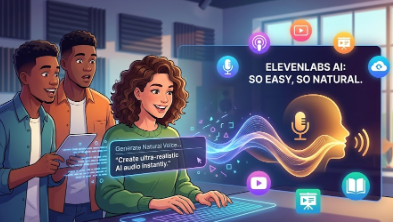
ElevenLabs Is Quietly Changing How the World Sounds Online
or years, the promise of realistic AI-generated voice felt perpetually out of reach. You'd demo a tool, get three sentences in, and the illusion would crack. A word stressed wrong. A pause that landed nowhere. That unmistakable flatness that tells your brain — before your conscious mind catches up — that nobody is actually speaking to you.
ElevenLabs, a voice AI company that has been steadily building a reputation among creators, developers, and media professionals, seems to have crossed that line. And what makes it genuinely interesting isn't just that it sounds good in English. It's what it's doing in Arabic, Hindi, Tamil, Italian, and dozens of other languages that has people paying attention.
The multilingual moment nobody saw coming
When most people think of AI voice generation, they picture an English-language product with a few international voices bolted on as an afterthought. Accented, stilted, clearly translated. The kind of voice that technically speaks your language but doesn't quite live in it.
ElevenLabs has approached this differently. Take Italian, for instance. The language is rhythmically expressive — syllables stretch and compress in ways that carry emotional meaning beyond the words themselves. Run a passage of Italian prose through most TTS engines and you get something that sounds like a textbook being read aloud. On ElevenLabs, the cadence shifts. The vowels linger where they're supposed to. A sentence delivered in frustration sounds different from one delivered in warmth, even without changing a word.
Arabic presents a different kind of challenge. It's a language with deep phonological complexity — sounds that don't exist in European languages, and a script that's read right to left with letters that change form depending on position. Historically this has made Arabic TTS one of the harder problems in the field. ElevenLabs handles Modern Standard Arabic with notable clarity, and several users in the Gulf and Levant regions have reported using it for explainer videos and e-learning content with results they describe as broadcast-appropriate.
Hindi sits at a fascinating crossroads. A large portion of digital Hindi content is actually a mixture — Hindi sentences peppered with English words, sometimes whole English phrases, what speakers call Hinglish. A voice engine that can only handle pure Hindi stumbles immediately when it hits "download karo" or "meeting pe jaana hai." ElevenLabs navigates this code-switching with a smoothness that has caught the attention of Indian content creators in particular, many of whom have been waiting years for a tool that handles how they actually speak, not how textbooks say they should.
Then there's Tamil — a classical language with over 70 million speakers and a distinct phonology that has long been underserved by mainstream AI tools. Tamil has retroflex consonants, sounds formed by curling the tongue back in ways that most voice models trained on European languages simply don't have representations for. The early results from ElevenLabs on Tamil have been described by users as imperfect but genuinely promising — a meaningful step beyond anything previously available, even if not yet at the level of the platform's English output.

No Comments have been Posted.